
Policy brief · 2023
¿Cuál fue el nivel de acuerdo en el pleno de la convención constitucional de 2021-2022?
Kenneth Bunker
Ideas: Laboratorio Democracia y Gobierno 6: 1-5
Bunker, K. (2023). ¿Cuál fue el nivel de acuerdo en el pleno de la convención constitucional de 2021-2022? (Ideas: Laboratorio Democracia y Gobierno, No. 6). Universidad San Sebastián, Laboratorio Democracia y Gobierno. https://doi.org/10.13140/RG.2.2.26767.76960
@techreport{bunker2023fue,
  author   = {Bunker, Kenneth},
  title    = {{¿Cuál fue el nivel de acuerdo en el pleno de la convención constitucional de 2021-2022?}},
  institution= {Universidad San Sebastián, Laboratorio Democracia y Gobierno},
  type     = {Ideas: Laboratorio Democracia y Gobierno},
  number   = {6},
  address  = {Santiago},
  year     = {2023},
  doi      = {10.13140/RG.2.2.26767.76960},
  url      = {https://kennethbunker.github.io/publications/ideas-06-cual-fue-nivel-acuerdo-pleno-convencion/},
  language = {spanish}
}
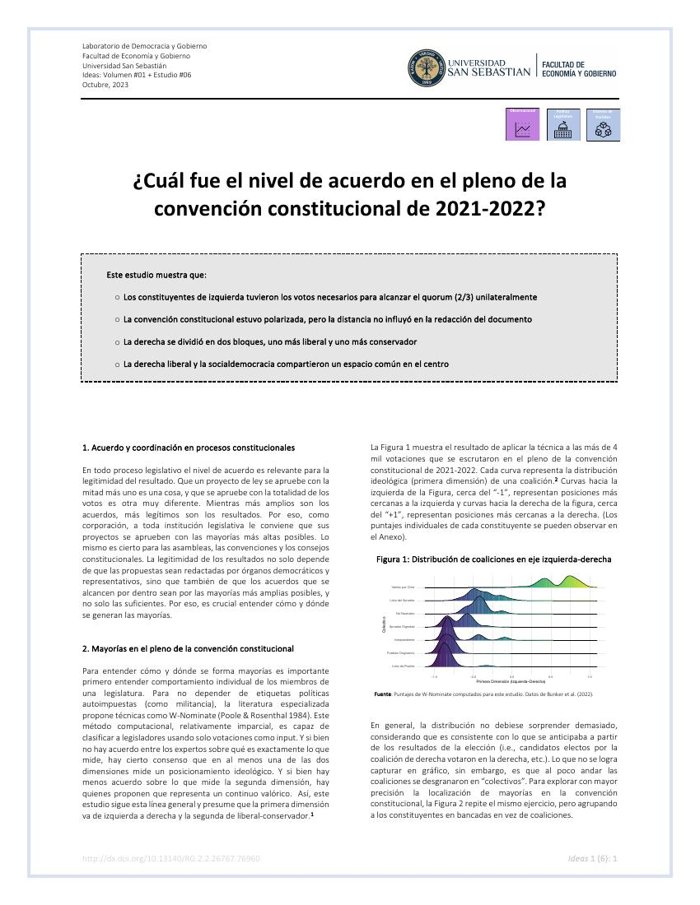 First page
Resumen
Este estudio examina el grado de consenso alcanzado en el pleno de la Convención Constitucional chilena durante 2021-2022. Los hallazgos indican que los constituyentes de izquierda poseían los votos necesarios para alcanzar el quórum de dos tercios de manera unilateral. A pesar de la polarización observada, esta no influyó significativamente en la redacción del documento final. Se identificó una división en la derecha en dos bloques: uno más liberal y otro más conservador.
Detalles
English version
Policy brief · 2023
What was the level of agreement in the plenary of the 2021-2022 Constitutional Convention?
Kenneth Bunker
Ideas: Laboratorio Democracia y Gobierno 6: 1-5
Abstract
This study examines the degree of consensus reached in the plenary of the Chilean Constitutional Convention during 2021-2022. The findings indicate that left-wing delegates had the votes needed to reach the two-thirds quorum unilaterally. Despite the polarization observed, it did not significantly influence the drafting of the final document. A split of the right into two blocs was identified: one more liberal and one more conservative.
Details
Profiles: Google Scholar / ORCID / ResearchGate / Academia.edu / Web of Science / CV