
Policy brief · 2023
¿Cuál fue el nivel de acuerdo en las comisiones de la convención constitucional de 2021-2022?
Kenneth Bunker
Ideas: Laboratorio Democracia y Gobierno 5: 1-5
Bunker, K. (2023). ¿Cuál fue el nivel de acuerdo en las comisiones de la convención constitucional de 2021-2022? (Ideas: Laboratorio Democracia y Gobierno, No. 5). Universidad San Sebastián, Laboratorio Democracia y Gobierno. https://doi.org/10.13140/RG.2.2.13345.99688
@techreport{bunker2023fue,
  author   = {Bunker, Kenneth},
  title    = {{¿Cuál fue el nivel de acuerdo en las comisiones de la convención constitucional de 2021-2022?}},
  institution= {Universidad San Sebastián, Laboratorio Democracia y Gobierno},
  type     = {Ideas: Laboratorio Democracia y Gobierno},
  number   = {5},
  address  = {Santiago},
  year     = {2023},
  doi      = {10.13140/RG.2.2.13345.99688},
  url      = {https://kennethbunker.github.io/publications/ideas-05-cual-fue-nivel-acuerdo-comisiones-convencion/},
  language = {spanish}
}
 First page
Resumen
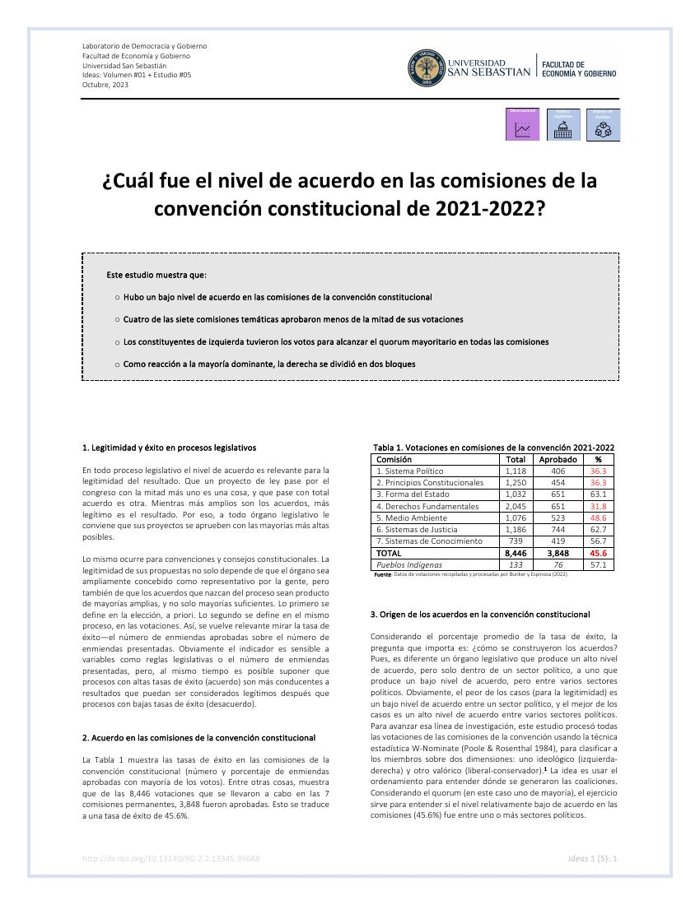
Este estudio analiza el grado de consenso alcanzado en las comisiones de la Convención Constitucional chilena durante 2021-2022. Los hallazgos indican un bajo nivel de acuerdo general, con cuatro de las siete comisiones temáticas aprobando menos de la mitad de sus votaciones. Los constituyentes de izquierda contaban con los votos necesarios para alcanzar el quórum mayoritario en todas las comisiones, mientras que, en respuesta, la derecha se dividió en dos bloques.
Detalles
English version
Policy brief · 2023
What was the level of agreement in the committees of the 2021-2022 Constitutional Convention?
Kenneth Bunker
Ideas: Laboratorio Democracia y Gobierno 5: 1-5
Abstract
This study analyzes the degree of consensus reached in the committees of the Chilean Constitutional Convention during 2021-2022. The findings indicate a low overall level of agreement, with four of the seven thematic committees approving less than half of their votes. Left-wing delegates had the votes needed to reach the majority quorum in all committees, while in response the right split into two blocs.
Details
Profiles: Google Scholar / ORCID / ResearchGate / Academia.edu / Web of Science / CV