
Journal article · 2026
Electoral Forecasting in Volatile Party System Settings: Assessing and Improving Pre-Election Poll Predictions in Italy
Kenneth Bunker
Social Science Computer Review 44(4): 595-616
Bunker, K. (2026). Electoral Forecasting in Volatile Party System Settings: Assessing and Improving Pre-Election Poll Predictions in Italy. Social Science Computer Review, 44(4), 595–616. https://doi.org/10.1177/08944393251328309
@article{bunker2026electoral,
  author   = {Bunker, Kenneth},
  title    = {{Electoral Forecasting in Volatile Party System Settings: Assessing and Improving Pre-Election Poll Predictions in Italy}},
  journal  = {Social Science Computer Review},
  volume   = {44},
  number   = {4},
  pages    = {595--616},
  year     = {2026},
  doi      = {10.1177/08944393251328309},
  url      = {https://kennethbunker.github.io/publications/2026-electoral-forecasting-volatile-party-system-settings-assessing/},
  language = {english}
}
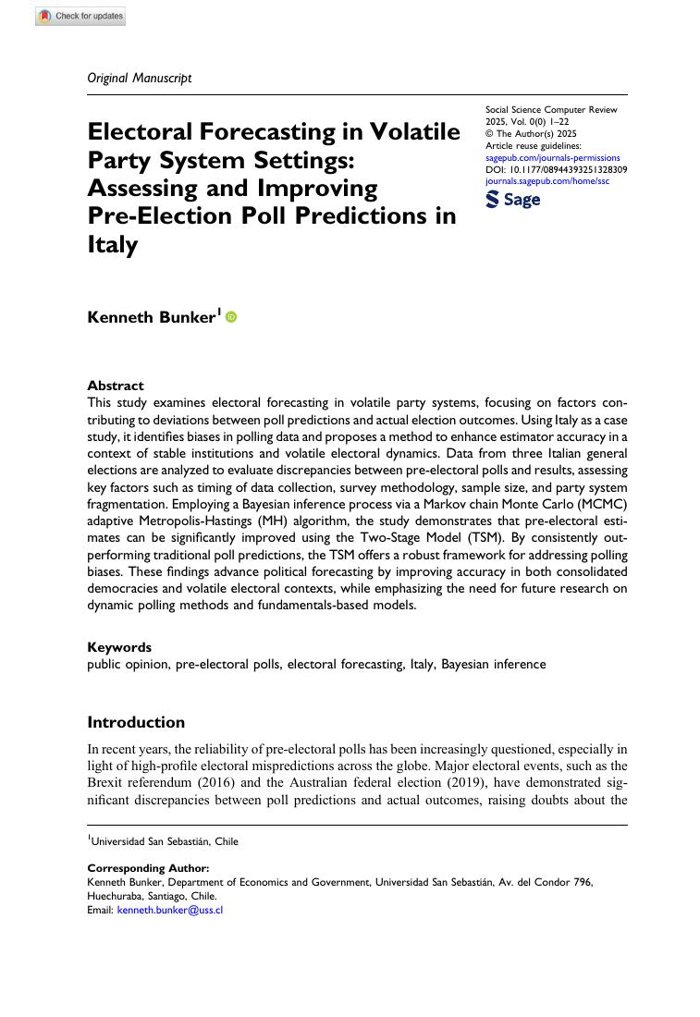 First page
Abstract
This study examines electoral forecasting in volatile party systems, focusing on factors contributing to deviations between poll predictions and actual election outcomes. Using Italy as a case study, it identifies biases in polling data and proposes a method to enhance estimator accuracy in a context of stable institutions and volatile electoral dynamics. Data from three Italian general elections are analyzed to evaluate discrepancies between pre-electoral polls and results, assessing key factors such as timing of data collection, survey methodology, sample size, and party system fragmentation. Employing a Bayesian inference process via a Markov chain Monte Carlo adaptive Metropolis-Hastings algorithm, the study demonstrates that pre-electoral estimates can be significantly improved using the Two-Stage Model. By consistently outperforming traditional poll predictions, the Two-Stage Model offers a robust framework for addressing polling biases. These findings advance political forecasting by improving accuracy in both consolidated democracies and volatile electoral contexts, while emphasizing the need for future research on dynamic polling methods and fundamentals-based models.
Details
Versión en español
Artículo · 2026
Pronóstico electoral en sistemas de partidos volátiles: evaluación y mejora de las predicciones de las encuestas preelectorales en Italia
Kenneth Bunker
Social Science Computer Review 44(4): 595-616
Resumen
Este estudio examina el pronóstico electoral en sistemas de partidos volátiles, centrándose en los factores que contribuyen a las desviaciones entre las predicciones de las encuestas y los resultados electorales. Usando Italia como caso de estudio, identifica sesgos en los datos de encuestas y propone un método para mejorar la precisión de los estimadores en un contexto de instituciones estables y dinámicas electorales volátiles. Se analizan datos de tres elecciones generales italianas para evaluar las discrepancias entre las encuestas preelectorales y los resultados, considerando factores clave como el momento de recolección de datos, la metodología de la encuesta, el tamaño de la muestra y la fragmentación del sistema de partidos. Empleando un proceso de inferencia bayesiana mediante un algoritmo Metropolis-Hastings adaptativo de cadenas de Markov Monte Carlo, el estudio demuestra que las estimaciones preelectorales pueden mejorarse significativamente con el Two-Stage Model (modelo de dos etapas). Al superar de manera consistente a las predicciones tradicionales de las encuestas, el modelo ofrece un marco sólido para abordar los sesgos de las encuestas. Estos hallazgos hacen avanzar el pronóstico político al mejorar la precisión tanto en democracias consolidadas como en contextos electorales volátiles, y subrayan la necesidad de investigar a futuro métodos dinámicos de encuestas y modelos basados en fundamentos.
Detalles
Profiles: Google Scholar / ORCID / ResearchGate / Academia.edu / Web of Science / CV