
Journal article · 2025
Decades of democracy: insights into the political landscape of Chile
Kenneth Bunker
Humanities and Social Sciences Communications 12, article 1911
Bunker, K. (2025). Decades of democracy: insights into the political landscape of Chile. Humanities and Social Sciences Communications, 12, 1911. https://doi.org/10.1057/s41599-025-06180-1
@article{bunker2025decades,
  author   = {Bunker, Kenneth},
  title    = {{Decades of democracy: insights into the political landscape of Chile}},
  journal  = {Humanities and Social Sciences Communications},
  volume   = {12},
  eid      = {1911},
  year     = {2025},
  doi      = {10.1057/s41599-025-06180-1},
  url      = {https://kennethbunker.github.io/publications/2025-decades-democracy-insights-into-political-landscape-chile/},
  language = {english}
}
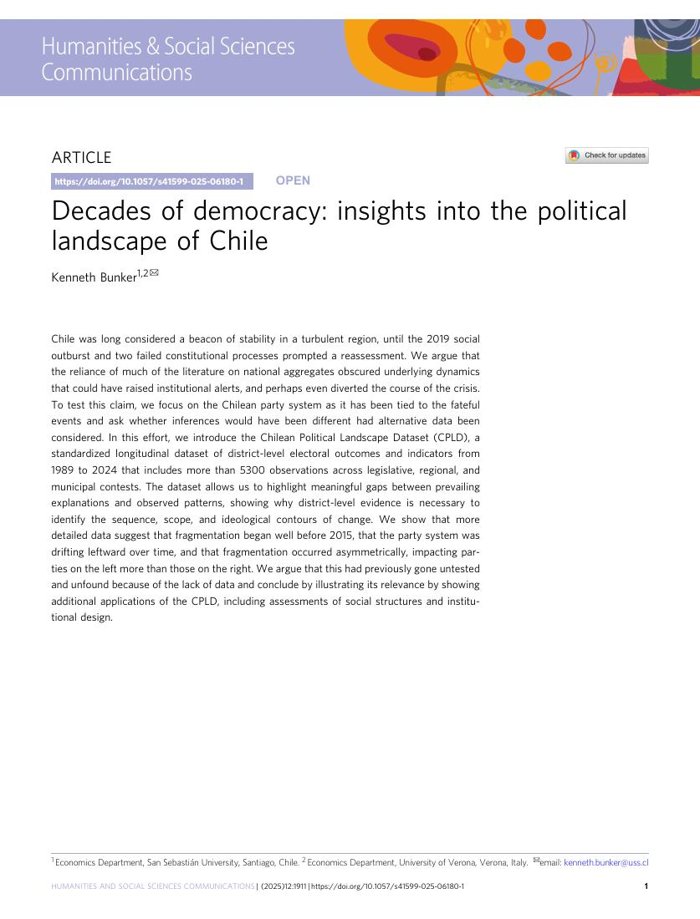 First page
Abstract
Chile was long considered a beacon of stability in a turbulent region, until the 2019 social outburst and two failed constitutional processes prompted a reassessment. We argue that the reliance of much of the literature on national aggregates obscured underlying dynamics that could have raised institutional alerts, and perhaps even diverted the course of the crisis. To test this claim, we focus on the Chilean party system as it has been tied to the fateful events and ask whether inferences would have been different had alternative data been considered. In this effort, we introduce the Chilean Political Landscape Dataset (CPLD), a standardized longitudinal dataset of district-level electoral outcomes and indicators from 1989 to 2024 that includes more than 5300 observations across legislative, regional, and municipal contests. The dataset allows us to highlight meaningful gaps between prevailing explanations and observed patterns, showing why district-level evidence is necessary to identify the sequence, scope, and ideological contours of change. We show that more detailed data suggest that fragmentation began well before 2015, that the party system was drifting leftward over time, and that fragmentation occurred asymmetrically, impacting parties on the left more than those on the right. We argue that this had previously gone untested and unfound because of the lack of data and conclude by illustrating its relevance by showing additional applications of the CPLD, including assessments of social structures and institutional design.
Details
Versión en español
Artículo · 2025
Décadas de democracia: claves sobre el panorama político de Chile
Kenneth Bunker
Humanities and Social Sciences Communications 12, artículo 1911
Resumen
Chile fue considerado por mucho tiempo un faro de estabilidad en una región turbulenta, hasta que el estallido social de 2019 y dos procesos constituyentes fallidos obligaron a reevaluarlo. Argumentamos que la dependencia de gran parte de la literatura en agregados nacionales ocultó dinámicas subyacentes que podrían haber encendido alertas institucionales, e incluso desviado el curso de la crisis. Para poner a prueba esta afirmación, nos centramos en el sistema de partidos chileno, por su vínculo con estos acontecimientos, y preguntamos si las inferencias habrían sido distintas de haberse considerado datos alternativos. Con este fin, presentamos la Chilean Political Landscape Dataset (CPLD), una base de datos longitudinal estandarizada de resultados e indicadores electorales a nivel de distrito entre 1989 y 2024, con más de 5.300 observaciones en elecciones legislativas, regionales y municipales. La base de datos permite destacar brechas significativas entre las explicaciones predominantes y los patrones observados, mostrando por qué la evidencia a nivel de distrito es necesaria para identificar la secuencia, el alcance y los contornos ideológicos del cambio. Mostramos que datos más detallados sugieren que la fragmentación comenzó mucho antes de 2015, que el sistema de partidos se fue desplazando hacia la izquierda con el tiempo y que la fragmentación ocurrió de manera asimétrica, afectando más a los partidos de izquierda que a los de derecha. Argumentamos que esto no había sido puesto a prueba ni detectado por falta de datos, y concluimos ilustrando su relevancia con aplicaciones adicionales de la CPLD, incluyendo evaluaciones de estructuras sociales y diseño institucional.
Detalles
Profiles: Google Scholar / ORCID / ResearchGate / Academia.edu / Web of Science / CV