
Journal article · 2024
The party system effects of unstable electoral rules in Latin America
Kenneth Bunker, Gabriel L. Negretto
Party Politics 30(6): 1126-1142
Bunker, K., & Negretto, G. L. (2024). The party system effects of unstable electoral rules in Latin America. Party Politics, 30(6), 1126–1142. https://doi.org/10.1177/13540688231196111
@article{bunker2024party,
  author   = {Bunker, Kenneth and Negretto, Gabriel L.},
  title    = {{The party system effects of unstable electoral rules in Latin America}},
  journal  = {Party Politics},
  volume   = {30},
  number   = {6},
  pages    = {1126--1142},
  year     = {2024},
  doi      = {10.1177/13540688231196111},
  url      = {https://kennethbunker.github.io/publications/2024-party-system-effects-unstable-electoral-rules-latin/},
  language = {english}
}
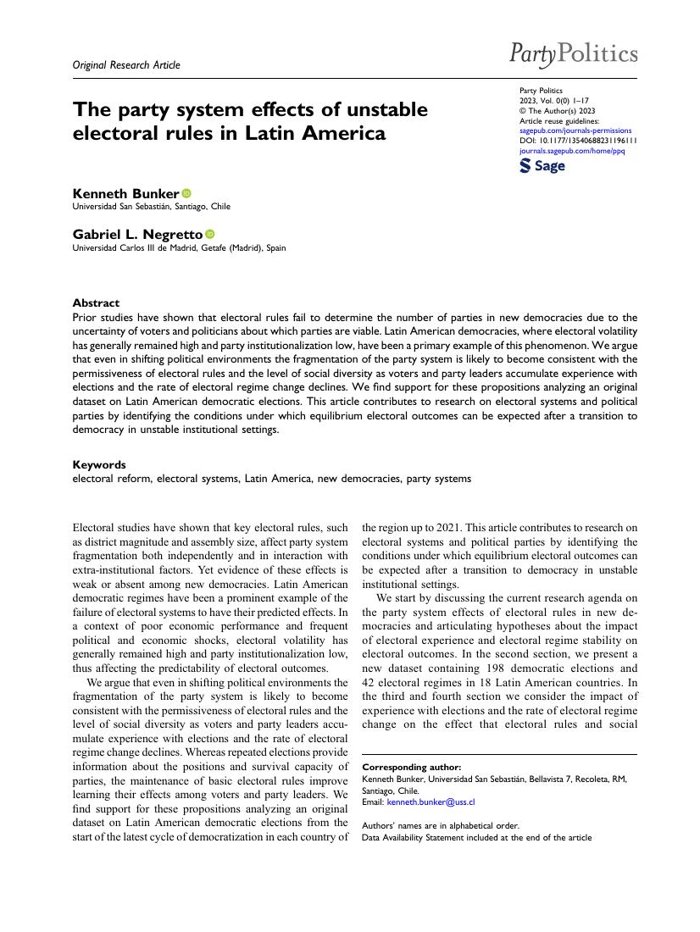 First page
Abstract
Prior studies have shown that electoral rules fail to determine the number of parties in new democracies due to the uncertainty of voters and politicians about which parties are viable. Latin American democracies, where electoral volatility has generally remained high and party institutionalization low, have been a primary example of this phenomenon. We argue that even in shifting political environments the fragmentation of the party system is likely to become consistent with the permissiveness of electoral rules and the level of social diversity as voters and party leaders accumulate experience with elections and the rate of electoral regime change declines. We find support for these propositions analyzing an original dataset on Latin American democratic elections. This article contributes to research on electoral systems and political parties by identifying the conditions under which equilibrium electoral outcomes can be expected after a transition to democracy in unstable institutional settings.
Details
Versión en español
Artículo · 2024
Los efectos de reglas electorales inestables sobre los sistemas de partidos en América Latina
Kenneth Bunker, Gabriel L. Negretto
Party Politics 30(6): 1126-1142
Resumen
Estudios previos han mostrado que las reglas electorales no logran determinar el número de partidos en las democracias nuevas debido a la incertidumbre de votantes y políticos sobre qué partidos son viables. Las democracias latinoamericanas, donde la volatilidad electoral se ha mantenido en general alta y la institucionalización partidaria baja, han sido un ejemplo principal de este fenómeno. Argumentamos que, incluso en entornos políticos cambiantes, la fragmentación del sistema de partidos tiende a ajustarse a la permisividad de las reglas electorales y al nivel de diversidad social a medida que votantes y líderes partidarios acumulan experiencia electoral y disminuye la frecuencia de cambios del régimen electoral. Encontramos respaldo para estas proposiciones analizando una base de datos original de elecciones democráticas latinoamericanas. Este artículo contribuye a la investigación sobre sistemas electorales y partidos políticos al identificar las condiciones bajo las cuales cabe esperar resultados electorales de equilibrio tras una transición a la democracia en contextos institucionales inestables.
Detalles
Profiles: Google Scholar / ORCID / ResearchGate / Academia.edu / Web of Science / CV