
Journal article · 2022
Forecasting two-horse races in new democracies: Accuracy, precision and error
Kenneth Bunker
Revista Latinoamericana de Opinión Pública 11(1): 81-108
Bunker, K. (2022). Forecasting two-horse races in new democracies: Accuracy, precision and error. Revista Latinoamericana de Opinión Pública, 11(1), 81–108. https://doi.org/10.14201/rlop.25374
@article{bunker2022forecasting,
  author   = {Bunker, Kenneth},
  title    = {{Forecasting two-horse races in new democracies: Accuracy, precision and error}},
  journal  = {Revista Latinoamericana de Opinión Pública},
  volume   = {11},
  number   = {1},
  pages    = {81--108},
  year     = {2022},
  doi      = {10.14201/rlop.25374},
  url      = {https://kennethbunker.github.io/publications/2022-forecasting-two-horse-races-new-democracies-accuracy/},
  language = {english}
}
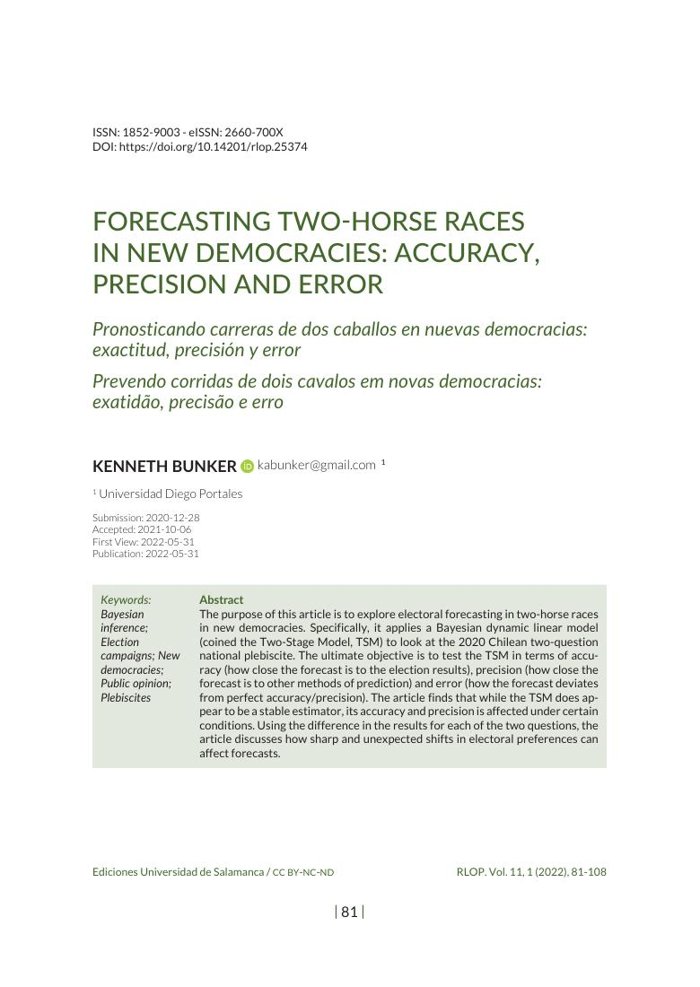 First page
Abstract
The purpose of this article is to explore electoral forecasting in two-horse races in new democracies. Specifically, it applies a Bayesian dynamic linear model (coined the Two-Stage Model, TSM) to look at the 2020 Chilean two-question national plebiscite. The ultimate objective is to test the TSM in terms of accuracy (how close the forecast is to the election results), precision (how close the forecast is to other methods of prediction) and error (how the forecast deviates from perfect accuracy/precision). The article finds that while the TSM does appear to be a stable estimator, its accuracy and precision is affected under certain conditions. Using the difference in the results for each of the two questions, the article discusses how sharp and unexpected shifts in electoral preferences can affect forecasts.
Details
Versión en español
Artículo · 2022
Pronosticando competencias entre dos alternativas en democracias nuevas: exactitud, precisión y error
Kenneth Bunker
Revista Latinoamericana de Opinión Pública 11(1): 81-108
Resumen
El propósito de este artículo es explorar el pronóstico electoral en competencias entre dos alternativas en democracias nuevas. En concreto, aplica un modelo lineal dinámico bayesiano (denominado Two-Stage Model, TSM) al plebiscito nacional chileno de 2020, de dos preguntas. El objetivo final es evaluar el TSM en términos de exactitud (cuán cerca está el pronóstico de los resultados electorales), precisión (cuán cerca está el pronóstico de otros métodos de predicción) y error (cómo se desvía el pronóstico de la exactitud o precisión perfecta). El artículo encuentra que, si bien el TSM parece ser un estimador estable, su exactitud y precisión se ven afectadas bajo ciertas condiciones. A partir de la diferencia en los resultados de cada una de las dos preguntas, el artículo discute cómo cambios bruscos e inesperados en las preferencias electorales pueden afectar los pronósticos.
Detalles
Profiles: Google Scholar / ORCID / ResearchGate / Academia.edu / Web of Science / CV