
Journal article · 2020
A two-stage model to forecast elections in new democracies
Kenneth Bunker
International Journal of Forecasting 36(4): 1407-1419
Bunker, K. (2020). A two-stage model to forecast elections in new democracies. International Journal of Forecasting, 36(4), 1407–1419. https://doi.org/10.1016/j.ijforecast.2020.02.004
@article{bunker2020two,
  author   = {Bunker, Kenneth},
  title    = {{A two-stage model to forecast elections in new democracies}},
  journal  = {International Journal of Forecasting},
  volume   = {36},
  number   = {4},
  pages    = {1407--1419},
  year     = {2020},
  doi      = {10.1016/j.ijforecast.2020.02.004},
  url      = {https://kennethbunker.github.io/publications/2020-two-stage-model-forecast-elections-new-democracies/},
  language = {english}
}
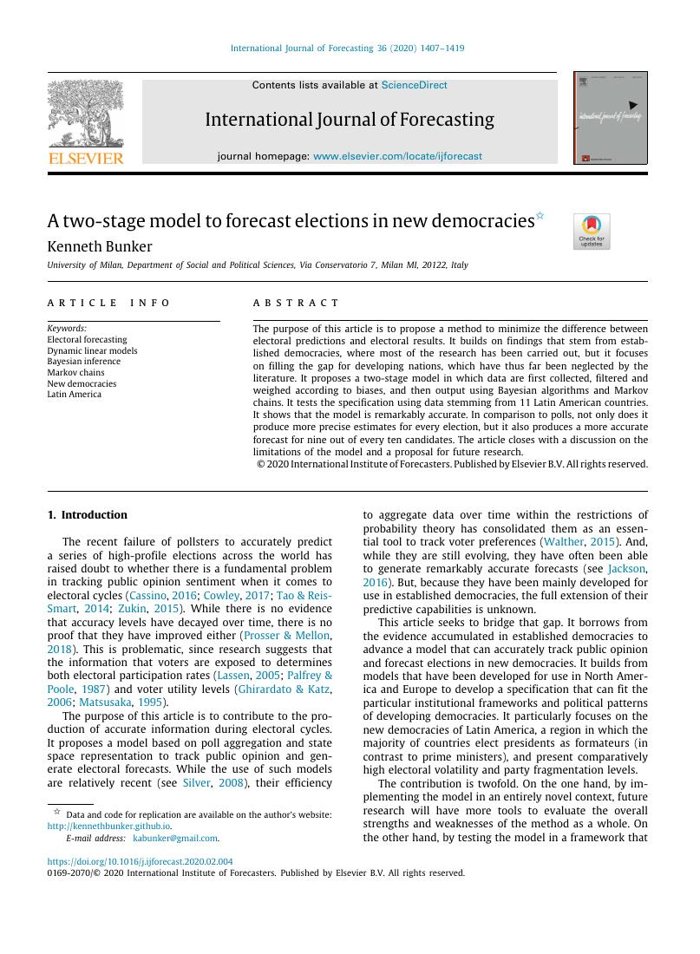 First page
Abstract
The purpose of this article is to propose a method to minimize the difference between electoral predictions and electoral results. It builds on findings that stem from established democracies, where most of the research has been carried out, but it focuses on filling the gap for developing nations, which have thus far been neglected by the literature. It proposes a two-stage model in which data are first collected, filtered and weighed according to biases, and then output using Bayesian algorithms and Markov chains. It tests the specification using data stemming from 11 Latin American countries. It shows that the model is remarkably accurate. In comparison to polls, not only does it produce more precise estimates for every election, but it also produces a more accurate forecast for nine out of every ten candidates. The article closes with a discussion on the limitations of the model and a proposal for future research.
Details
Versión en español
Artículo · 2020
Un modelo de dos etapas para pronosticar elecciones en democracias nuevas
Kenneth Bunker
International Journal of Forecasting 36(4): 1407-1419
Resumen
El propósito de este artículo es proponer un método para minimizar la diferencia entre las predicciones electorales y los resultados electorales. Se basa en hallazgos provenientes de democracias establecidas, donde se ha concentrado la mayor parte de la investigación, pero busca llenar el vacío respecto de los países en desarrollo, hasta ahora desatendidos por la literatura. Propone un modelo de dos etapas en el que los datos primero se recolectan, filtran y ponderan según sus sesgos, y luego se procesan mediante algoritmos bayesianos y cadenas de Markov. Pone a prueba la especificación con datos de 11 países latinoamericanos. Muestra que el modelo es notablemente exacto. En comparación con las encuestas, no solo produce estimaciones más precisas para cada elección, sino que también genera un pronóstico más exacto para nueve de cada diez candidatos. El artículo cierra con una discusión sobre las limitaciones del modelo y una propuesta para investigaciones futuras.
Detalles
Profiles: Google Scholar / ORCID / ResearchGate / Academia.edu / Web of Science / CV