
Journal article · 2019
Why do parties cooperate in presidentialism? Electoral and government coalition formation in Latin America
Kenneth Bunker
Revista de Estudios Políticos(186): 171-199
Bunker, K. (2019). Why do parties cooperate in presidentialism? Electoral and government coalition formation in Latin America. Revista de Estudios Políticos, 186, 171–199. https://doi.org/10.18042/cepc/rep.186.06
@article{bunker2019why,
  author   = {Bunker, Kenneth},
  title    = {{Why do parties cooperate in presidentialism? Electoral and government coalition formation in Latin America}},
  journal  = {Revista de Estudios Políticos},
  number   = {186},
  pages    = {171--199},
  year     = {2019},
  doi      = {10.18042/cepc/rep.186.06},
  url      = {https://kennethbunker.github.io/publications/2019-why-do-parties-cooperate-presidentialism-electoral-government/},
  language = {english}
}
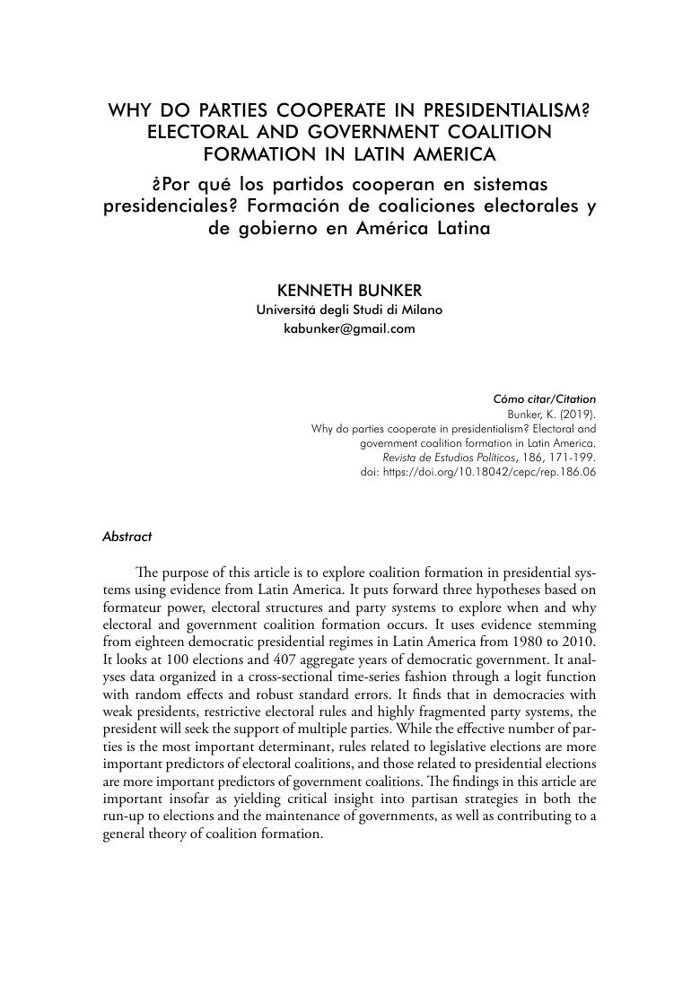 First page
Abstract
The purpose of this article is to explore coalition formation in presidential systems using evidence from Latin America. It puts forward three hypotheses based on formateur power, electoral structures and party systems to explore when and why electoral and government coalition formation occurs. It uses evidence stemming from eighteen democratic presidential regimes in Latin America from 1980 to 2010. It looks at 100 elections and 407 aggregate years of democratic government. It analyses data organized in a cross-sectional time-series fashion through a logit function with random effects and robust standard errors. It finds that in democracies with weak presidents, restrictive electoral rules and highly fragmented party systems, the president will seek the support of multiple parties. While the effective number of parties is the most important determinant, rules related to legislative elections are more important predictors of electoral coalitions, and those related to presidential elections are more important predictors of government coalitions. The findings in this article are important insofar as yielding critical insight into partisan strategies in both the run-up to elections and the maintenance of governments, as well as contributing to a general theory of coalition formation.
Details
Versión en español
Artículo · 2019
¿Por qué cooperan los partidos en el presidencialismo? Formación de coaliciones electorales y de gobierno en América Latina
Kenneth Bunker
Revista de Estudios Políticos(186): 171-199
Resumen
El propósito de este artículo es explorar la formación de coaliciones en sistemas presidenciales con evidencia de América Latina. Plantea tres hipótesis basadas en el poder del formador, las estructuras electorales y los sistemas de partidos para explorar cuándo y por qué se forman coaliciones electorales y de gobierno. Utiliza evidencia de dieciocho regímenes presidenciales democráticos de América Latina entre 1980 y 2010. Examina 100 elecciones y 407 años agregados de gobierno democrático. Analiza datos organizados como series de tiempo transversales mediante una función logit con efectos aleatorios y errores estándar robustos. Encuentra que en democracias con presidentes débiles, reglas electorales restrictivas y sistemas de partidos muy fragmentados, el presidente buscará el apoyo de múltiples partidos. Si bien el número efectivo de partidos es el determinante más importante, las reglas de las elecciones legislativas son mejores predictores de las coaliciones electorales, y las de las elecciones presidenciales son mejores predictores de las coaliciones de gobierno. Los hallazgos de este artículo son importantes en la medida en que aportan una comprensión clave de las estrategias partidarias tanto en la antesala de las elecciones como en la mantención de los gobiernos, además de contribuir a una teoría general de la formación de coaliciones.
Detalles
Profiles: Google Scholar / ORCID / ResearchGate / Academia.edu / Web of Science / CV