
Journal article · 2019
Voter Equalization and Turnout Bias After Electoral Reform: Evidence from Chile’s Voluntary Voting Law
Daniel Brieba, Kenneth Bunker
Latin American Politics and Society 61(4): 23-46
Brieba, D., & Bunker, K. (2019). Voter Equalization and Turnout Bias After Electoral Reform: Evidence from Chile’s Voluntary Voting Law. Latin American Politics and Society, 61(4), 23–46. https://doi.org/10.1017/lap.2019.23
@article{brieba2019voter,
  author   = {Brieba, Daniel and Bunker, Kenneth},
  title    = {{Voter Equalization and Turnout Bias After Electoral Reform: Evidence from Chile’s Voluntary Voting Law}},
  journal  = {Latin American Politics and Society},
  volume   = {61},
  number   = {4},
  pages    = {23--46},
  year     = {2019},
  doi      = {10.1017/lap.2019.23},
  url      = {https://kennethbunker.github.io/publications/2019-voter-equalization-turnout-bias-after-electoral-reform/},
  language = {english}
}
 First page
Abstract
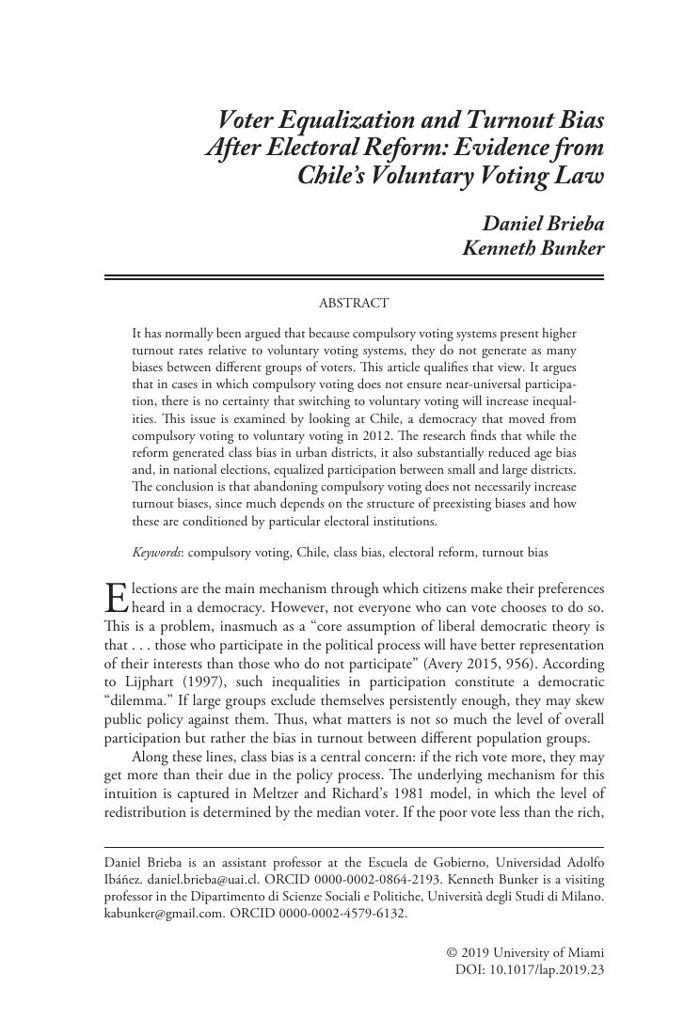
It has normally been argued that because compulsory voting systems present higher turnout rates relative to voluntary voting systems, they do not generate as many biases between different groups of voters. This article qualifies that view. It argues that in cases in which compulsory voting does not ensure near-universal participation, there is no certainty that switching to voluntary voting will increase inequalities. This issue is examined by looking at Chile, a democracy that moved from compulsory to voluntary voting in 2012. The research finds that while the reform generated class bias in urban districts, it also substantially reduced age bias and, in national elections, equalized participation between small and large districts. The conclusion is that abandoning compulsory voting does not necessarily increase turnout biases, since much depends on the structure of preexisting biases, and how these are conditioned by particular electoral institutions.
Details
Versión en español
Artículo · 2019
Igualación de votantes y sesgo de participación tras una reforma electoral: evidencia de la ley de voto voluntario en Chile
Daniel Brieba, Kenneth Bunker
Latin American Politics and Society 61(4): 23-46
Resumen
Se ha argumentado normalmente que, como los sistemas de voto obligatorio presentan tasas de participación más altas que los de voto voluntario, no generan tantos sesgos entre distintos grupos de votantes. Este artículo matiza esa visión. Argumenta que, en los casos en que el voto obligatorio no asegura una participación casi universal, no hay certeza de que el cambio a voto voluntario aumente las desigualdades. El tema se examina a partir del caso de Chile, una democracia que pasó del voto obligatorio al voluntario en 2012. La investigación encuentra que, si bien la reforma generó un sesgo de clase en los distritos urbanos, también redujo sustancialmente el sesgo etario y, en elecciones nacionales, igualó la participación entre distritos pequeños y grandes. La conclusión es que abandonar el voto obligatorio no necesariamente aumenta los sesgos de participación, ya que mucho depende de la estructura de los sesgos preexistentes y de cómo estos son condicionados por instituciones electorales específicas.
Detalles
Profiles: Google Scholar / ORCID / ResearchGate / Academia.edu / Web of Science / CV