
Journal article · 2015
Incumbency Advantage and Tenure Length in the Chilean Chamber of Deputies, 1989-2009
Kenneth Bunker, Patricio Navia
Revista de Ciencia Política 35(2): 251-271
Bunker, K., & Navia, P. (2015). Incumbency Advantage and Tenure Length in the Chilean Chamber of Deputies, 1989-2009. Revista de Ciencia Política, 35(2), 251–271. https://doi.org/10.4067/S0718-090X2015000200001
@article{bunker2015incumbency,
  author   = {Bunker, Kenneth and Navia, Patricio},
  title    = {{Incumbency Advantage and Tenure Length in the Chilean Chamber of Deputies, 1989-2009}},
  journal  = {Revista de Ciencia Política},
  volume   = {35},
  number   = {2},
  pages    = {251--271},
  year     = {2015},
  doi      = {10.4067/S0718-090X2015000200001},
  url      = {https://kennethbunker.github.io/publications/2015-incumbency-advantage-tenure-length-chilean-chamber-deputies/},
  language = {english}
}
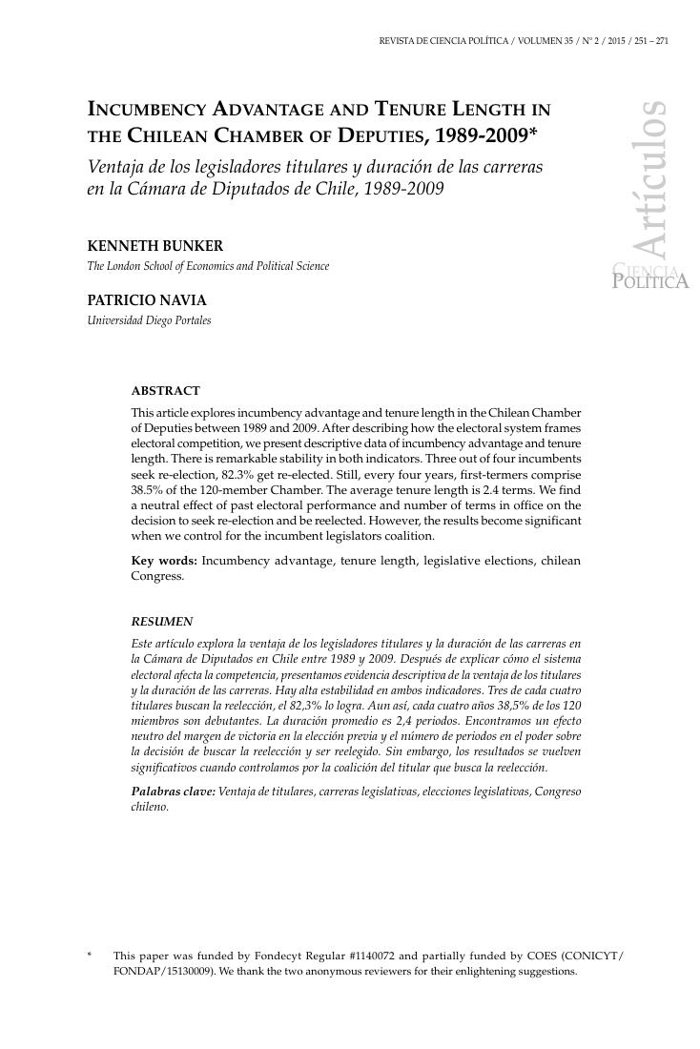 First page
Abstract
This article explores incumbency advantage and tenure length in the Chilean Chamber of Deputies between 1989 and 2009. After describing how the electoral system frames electoral competition, we present descriptive data of incumbency advantage and tenure length. There is remarkable stability in both indicators. Three out of four incumbents seek re-election, 82.3% get re-elected. Still, every four years, first-termers comprise 38.5% of the 120-member Chamber. The average tenure length is 2.4 terms. We find a neutral effect of past electoral performance and number of terms in office on the decision to seek re-election and be reelected. However, the results become significant when we control for the incumbent legislators coalition.
Details
Versión en español
Artículo · 2015
Ventaja del incumbente y duración de las carreras en la Cámara de Diputados de Chile, 1989-2009
Kenneth Bunker, Patricio Navia
Revista de Ciencia Política 35(2): 251-271
Resumen
Este artículo explora la ventaja del incumbente y la duración de las carreras en la Cámara de Diputados de Chile entre 1989 y 2009. Tras describir cómo el sistema electoral enmarca la competencia electoral, presentamos datos descriptivos sobre la ventaja del incumbente y la duración de las carreras. Hay una notable estabilidad en ambos indicadores. Tres de cada cuatro incumbentes buscan la reelección y el 82,3% es reelecto. Aun así, cada cuatro años, los diputados en su primer período representan el 38,5% de la Cámara de 120 miembros. La duración promedio de las carreras es de 2,4 períodos. Encontramos un efecto neutro del desempeño electoral previo y del número de períodos en el cargo sobre la decisión de buscar la reelección y de ser reelecto. Sin embargo, los resultados se vuelven significativos cuando controlamos por la coalición del legislador incumbente.
Detalles
Profiles: Google Scholar / ORCID / ResearchGate / Academia.edu / Web of Science / CV